
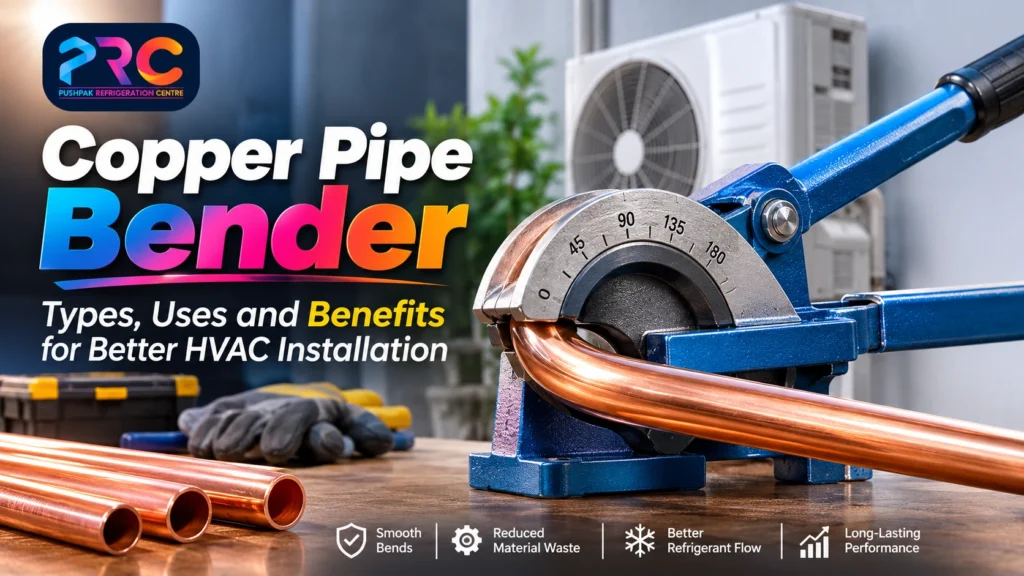
A Copper Pipe Bender is an essential tool for shaping copper tubes without flattening, twisting, or damaging their structure. It helps HVAC technicians create smooth bends, maintain proper refrigerant flow, and complete air conditioning installations with greater accuracy. Understanding its types, uses, and benefits can help contractors and HVAC businesses improve installation quality, reduce material waste, and achieve reliable system performance.
A Copper Pipe Bender is a specialised hand-operated or mechanical tool designed to bend copper tubing into different angles and shapes without cutting the pipe. It applies controlled pressure to the tube, allowing technicians to create smooth curves while maintaining its original shape and internal diameter. This is especially important in HVAC applications, where copper pipes carry refrigerant between indoor and outdoor air conditioning units.
During an air conditioner installation, copper pipes often need to pass around walls, corners, electrical components, and other equipment. Bending the pipes correctly helps technicians complete these connections without using unnecessary joints or fittings. It also creates a cleaner installation and reduces the chances of leakage caused by poorly made connections.
Copper tubing is widely used in refrigeration and air conditioning because of its heat transfer properties, durability, and ability to handle different operating conditions. However, improper bending can lead to kinks, cracks, and restricted refrigerant flow. Using the correct bending tool helps prevent these problems and supports the long-term performance of HVAC equipment.
Copper pipes play an important role in transferring refrigerant throughout an air conditioning system. Their condition directly affects how efficiently the system operates. When a pipe is bent incorrectly, its internal diameter may become smaller, restricting refrigerant movement and creating additional pressure within the system.
Proper bending helps maintain a consistent pipe shape and allows refrigerant to move through the system without unnecessary restrictions. It also makes installations easier in compact spaces where technicians have limited room to work.
For example, when installing a split air conditioner in a small commercial office, technicians may need to route copper tubing through narrow gaps behind the indoor unit. A suitable bending tool helps create the required curve without damaging the tube. This saves installation time and reduces the need to replace damaged copper sections.
For HVAC contractors handling multiple projects, consistent bending practices can improve work quality, reduce material wastage, and make installations more professional.
Not every copper pipe bending tool is designed for the same application. The right choice depends on the tube diameter, copper material, bending angle, installation space, and working conditions. Understanding the available options helps technicians select a tool that matches their requirements.
A handheld copper pipe bender is commonly used for small-scale HVAC installations and repair work. It is operated manually and usually includes a handle, bending guide, and supporting mechanism that helps control the bending angle.
This type of tool is useful when technicians need to make simple bends in copper tubing while installing split air conditioners, refrigerators, and other cooling equipment. Its compact design makes it convenient to carry between different job sites.
Handheld models are particularly suitable for technicians who regularly work with smaller copper tubes. They provide better control than bending pipes manually and help create consistent curves with less effort.
A lever-type bender uses mechanical leverage to apply pressure to copper tubing. The longer handle allows technicians to bend pipes with less physical effort while maintaining better control over the bending process.
This tool is useful when working with copper tubes that require more controlled bending or when several bends need to be completed during an installation. It also helps reduce the risk of uneven curves caused by applying pressure directly by hand.
Lever-type models are commonly selected for professional HVAC work because they provide a balance between ease of use, accuracy, and portability.
A ratchet copper pipe bender uses a controlled mechanical movement to bend tubing gradually. Instead of applying all the pressure at once, the ratchet mechanism allows technicians to work through the bending process in smaller steps.
This makes it easier to handle certain bending requirements, particularly when working in restricted spaces. The mechanism also helps maintain control over the bending angle and reduces the physical effort needed during repeated operations.
For technicians handling regular installation and maintenance work, ratchet-style tools can improve convenience and consistency.
A spring-type bender is a simple tool that fits around or inside copper tubing, depending on its design. It supports the pipe walls while the technician bends the tube manually.
The spring provides support throughout the bending process and helps reduce the chances of flattening or kinking. These tools are generally useful for smaller-diameter copper tubing and straightforward bending applications.
However, technicians must select the correct spring size according to the pipe's outside diameter. Using an unsuitable spring may provide insufficient support or make the bending process difficult.
A hydraulic pipe bender uses hydraulic pressure to bend metal tubing with controlled force. It is generally designed for larger or heavier-duty applications where manual bending may require considerable effort.
These machines are more suitable for industrial workshops, manufacturing operations, and specialised fabrication work. They can provide consistent bending results when properly set up with compatible tooling.
For regular residential air conditioning installations, a hydraulic model may not be necessary. However, businesses handling larger copper tubing or specialised HVAC fabrication may benefit from its capabilities.
Copper pipe bending is an important part of several HVAC installation and maintenance activities. Technicians use bending tools to create suitable pipe routes while maintaining the required shape and functionality of copper tubing.
Split air conditioners require copper tubing to connect indoor and outdoor units. These pipes often need to pass through walls, narrow openings, and corners. A suitable bending tool helps technicians create smooth curves according to the installation layout.
Proper bending also reduces the need for additional fittings, helping create a cleaner and more organised installation.
Commercial refrigerators, cold storage units, and refrigeration equipment depend on copper tubing for refrigerant circulation. These systems may have different piping layouts depending on their design and cooling capacity.
A pipe bender helps technicians shape copper tubes around equipment while maintaining proper routing. This is especially useful in commercial environments where space management and installation accuracy are important.
During maintenance work, technicians may need to replace damaged copper tubing or adjust existing pipe connections. A bending tool helps them shape replacement sections according to the available installation space.
It can also help reduce unnecessary pipe cutting and additional joints, provided the existing system layout and manufacturer instructions allow the required modification.
Commercial buildings, offices, hotels, and retail spaces often use larger or more complex cooling systems. Their copper piping networks may require several bends to connect different components.
Using suitable bending equipment helps installation teams maintain organised pipe routes and complete work with greater precision.
Selecting the right bending tool can improve more than just the appearance of copper tubing. It can also influence installation time, material usage, and the overall quality of HVAC work.
One of the biggest benefits of using a proper bending tool is reduced pipe damage. Applying uneven pressure or bending copper tubing without suitable support can cause kinks, cracks, and flattened sections.
A suitable bender distributes pressure more evenly, helping technicians maintain the pipe's shape during bending.
A smooth bend helps preserve the internal passage of copper tubing. This is important because restrictions in refrigerant lines can affect system performance and operating conditions.
Correct bending practices help reduce unnecessary restrictions and support reliable refrigerant circulation.
Making accurate bends with a suitable tool can reduce repeated adjustments and unnecessary cutting. Technicians can complete pipe routing more efficiently, particularly when working on installations that require multiple bends.
For businesses managing several installation projects, even small time savings can improve daily productivity.
Damaged copper tubing often needs to be cut out and replaced. This increases material consumption and can add to project costs.
Using the right bending equipment helps reduce avoidable damage, allowing technicians to use copper tubing more efficiently.
Visible copper piping is common in residential and commercial air conditioning installations. Uneven bends and unnecessary joints can make an installation look untidy.
A proper bending tool helps create smooth curves and organised pipe layouts, improving the overall appearance of the completed work.
Choosing a suitable bending tool requires more than comparing prices. HVAC professionals should consider the type of work they perform, the copper tubing specifications, and the level of accuracy required.
The first consideration should be the pipe diameter. Every bending tool is designed for specific tube sizes, so its compatibility should match the outside diameter of the copper tubing. Using an unsuitable tool may result in poor bending quality or pipe deformation.
The type of copper tubing also matters. Different copper tube grades and tempers can have different bending characteristics. Technicians should follow the manufacturer's recommendations to select suitable bending equipment and avoid excessive force.
Another important factor is the bending radius. Every copper tube has a minimum recommended bending radius based on its dimensions and material properties. Bending below the recommended limit can increase the risk of flattening, wrinkling, or cracking.
Technicians should also consider portability, ease of operation, durability, and the frequency of use. A compact handheld model may be sufficient for occasional residential installations, while contractors handling regular commercial work may prefer more advanced equipment.
Even when using a quality tool, incorrect bending practices can damage copper tubing. Understanding common mistakes helps technicians achieve better results and avoid unnecessary replacement costs.
One common mistake is selecting the wrong bender size. A tool that does not match the pipe diameter may fail to support the tubing properly, resulting in uneven bends or deformation.
Another mistake is applying excessive pressure during bending. Copper tubing needs controlled force, and rushing the process can damage the pipe walls. Technicians should follow the tool manufacturer's instructions and bend the tube gradually where the tool design requires it.
Ignoring the minimum bending radius is another issue. A bend that is too tight can restrict the internal passage and affect the performance of the refrigeration system.
Technicians should also avoid bending damaged, cracked, or unsuitable tubing. Before starting work, they should inspect the copper tube and ensure it is appropriate for the intended application.
Finally, proper support and alignment are important. The pipe should be positioned correctly in the bending tool to prevent twisting and uneven pressure.
A good bending tool can improve installation accuracy, but the quality of copper tubing is equally important. Poor-quality or unsuitable tubing may not provide the required strength, flexibility, or durability for HVAC applications.
When purchasing copper pipes, businesses should consider material specifications, wall thickness, tube dimensions, surface quality, and suitability for the intended refrigeration or air conditioning system. These factors help determine whether the tubing can meet the operating requirements of the equipment.
Businesses looking for reliable sourcing options can explore established Copper Pipe Manufacturers in Tamil Nadu to understand available product specifications and supply capabilities. Comparing product quality and technical information helps contractors and procurement teams make informed purchasing decisions.
Working with dependable suppliers also helps businesses maintain consistency across multiple installation projects. This is particularly useful for contractors who require regular copper tubing supplies for residential and commercial HVAC applications.
For HVAC contractors, equipment dealers, and installation businesses, finding the right copper pipe supplier is an important part of managing project costs and maintaining product availability.
When comparing Copper Pipe Dealers in Tamil Nadu, buyers should consider whether the available copper tubing matches their required dimensions and application specifications. Product availability, pricing transparency, material quality, and delivery arrangements should also be evaluated before placing an order.
Businesses purchasing copper tubing in larger quantities may also benefit from comparing wholesale supply options. A reliable Copper Pipe Wholesaler in Tamil Nadu can help contractors and commercial buyers manage recurring material requirements more efficiently.
For businesses operating across multiple locations, supply consistency is another important consideration. A dependable Copper Pipe Distributor in Tamil Nadu can help improve access to suitable copper tubing and support regular procurement needs.
Rather than selecting a supplier based only on the lowest price, buyers should evaluate product documentation, technical specifications, quality standards, and after-sales support. This approach can help reduce procurement problems and improve the reliability of HVAC installation projects.
The HVAC industry continues to evolve as buildings demand better energy efficiency, improved cooling performance, and more space-efficient installations. These changes are also influencing how technicians approach copper pipe fabrication and installation.
Modern bending equipment is becoming more focused on precision, ease of operation, and repeatable results. Advanced tools can help technicians achieve consistent bends while reducing the physical effort involved in repetitive work.
Training and proper tool selection will remain important as HVAC systems become more specialised. Technicians who understand copper tubing specifications, bending limits, and installation practices will be better prepared to handle different project requirements.
There is also growing attention towards reducing material waste and improving installation quality. Proper pipe routing and accurate bending support these goals by helping businesses avoid unnecessary cuts, additional fittings, and replacement work.
A Copper Pipe Bender plays an important role in achieving accurate, efficient, and reliable HVAC installations. From residential air conditioning systems to commercial refrigeration applications, the right bending tool helps technicians create smooth curves, minimise pipe damage, and maintain better installation quality.
Understanding the different types of benders, their applications, and the correct bending practices can help HVAC businesses improve productivity while controlling material costs. However, selecting suitable copper tubing is equally important for achieving dependable results.
Whether you are an HVAC contractor, refrigeration technician, or equipment supplier, investing in appropriate bending tools and quality copper pipes can make a meaningful difference to your work. Explore reliable copper tubing solutions and choose products that match your technical requirements for better and more efficient HVAC applications.
A Copper Pipe Bender is used to bend copper tubing into different angles and shapes without damaging its structure. It helps maintain the pipe's original diameter and prevents flattening, twisting, or kinking during installation. This tool is widely used in HVAC systems, air conditioning units, refrigeration equipment, and plumbing applications where accurate pipe routing is important.
Yes, copper pipes can sometimes be bent manually using suitable bending springs or other approved methods, particularly when working with smaller tube sizes. However, bending without proper support increases the risk of creating sharp curves, wrinkles, or flattened sections. Using a suitable pipe bender provides better control over the bending angle and helps maintain the pipe's shape, making it a more reliable option for professional HVAC installations.
There are several types of copper pipe benders available for different applications. Common options include handheld, lever-type, ratchet, spring-type, and hydraulic pipe benders. Handheld and spring benders are generally suitable for smaller tubing and basic installation work, while lever and ratchet models provide better mechanical assistance. Hydraulic benders are more commonly used for larger or specialised fabrication requirements.
Yes, improper bending can affect refrigerant flow by reducing the internal diameter of the copper tubing. When a pipe becomes flattened or kinked, it can create unwanted restrictions within the refrigeration circuit and affect system operating conditions. Using the correct bending tool and following the recommended bending radius helps maintain the pipe's internal passage and supports efficient air conditioning and refrigeration system operation.
The correct bending radius depends on several factors, including the outside diameter, wall thickness, copper temper, and bending method. A smaller bending radius requires greater deformation of the pipe walls, which can increase the risk of flattening, wrinkling, or cracking. HVAC technicians should always follow the copper tube manufacturer's recommendations and the bending tool's specifications to achieve smooth and reliable bends.
Yes, a copper pipe bender is an important tool for air conditioning installation. Technicians use it to shape refrigerant lines when connecting indoor and outdoor AC units, routing pipes through walls, and working around corners or restricted spaces. It helps create smooth curves, reduces unnecessary pipe joints, and improves the overall appearance of the installation. Selecting a bender that matches the copper tube size is essential for achieving accurate results.
The best copper pipe bender depends on the type of HVAC work, tube diameter, and installation requirements. Handheld and lever-type models are suitable for many standard residential air conditioning installations because they are portable and easy to operate. Ratchet-style benders can provide additional control during certain bending operations. For larger tubing and specialised fabrication work, more advanced mechanical or hydraulic equipment may be appropriate.
Copper pipes usually develop kinks when excessive pressure is applied, the wrong bending tool is selected, or the pipe is bent beyond its recommended radius. Incorrect positioning inside the tool can also create uneven pressure and damage the tubing. To prevent kinking, technicians should select the correct tool size, align the pipe properly, and apply controlled pressure throughout the bending process. Inspecting the tubing before installation is equally important.
When purchasing copper pipes for HVAC applications, buyers should consider the outside diameter, wall thickness, copper grade, temper, pressure requirements, and compatibility with the intended refrigeration system. The tubing should meet the relevant technical specifications and be suitable for the operating conditions of the equipment. It is also important to evaluate the supplier's product quality, availability, pricing, and documentation to ensure consistent material quality across different installation projects.
Finding reliable copper pipe suppliers in Tamil Nadu requires comparing manufacturers, dealers, wholesalers, and distributors based on product quality and business requirements. Check the copper tubing specifications, available sizes, quality documentation, pricing transparency, and delivery capabilities before making a purchasing decision. Businesses handling regular HVAC installations should also consider supply consistency and technical support. Choosing a dependable supplier can help reduce procurement delays and ensure access to suitable copper tubing for residential and commercial refrigeration projects.