
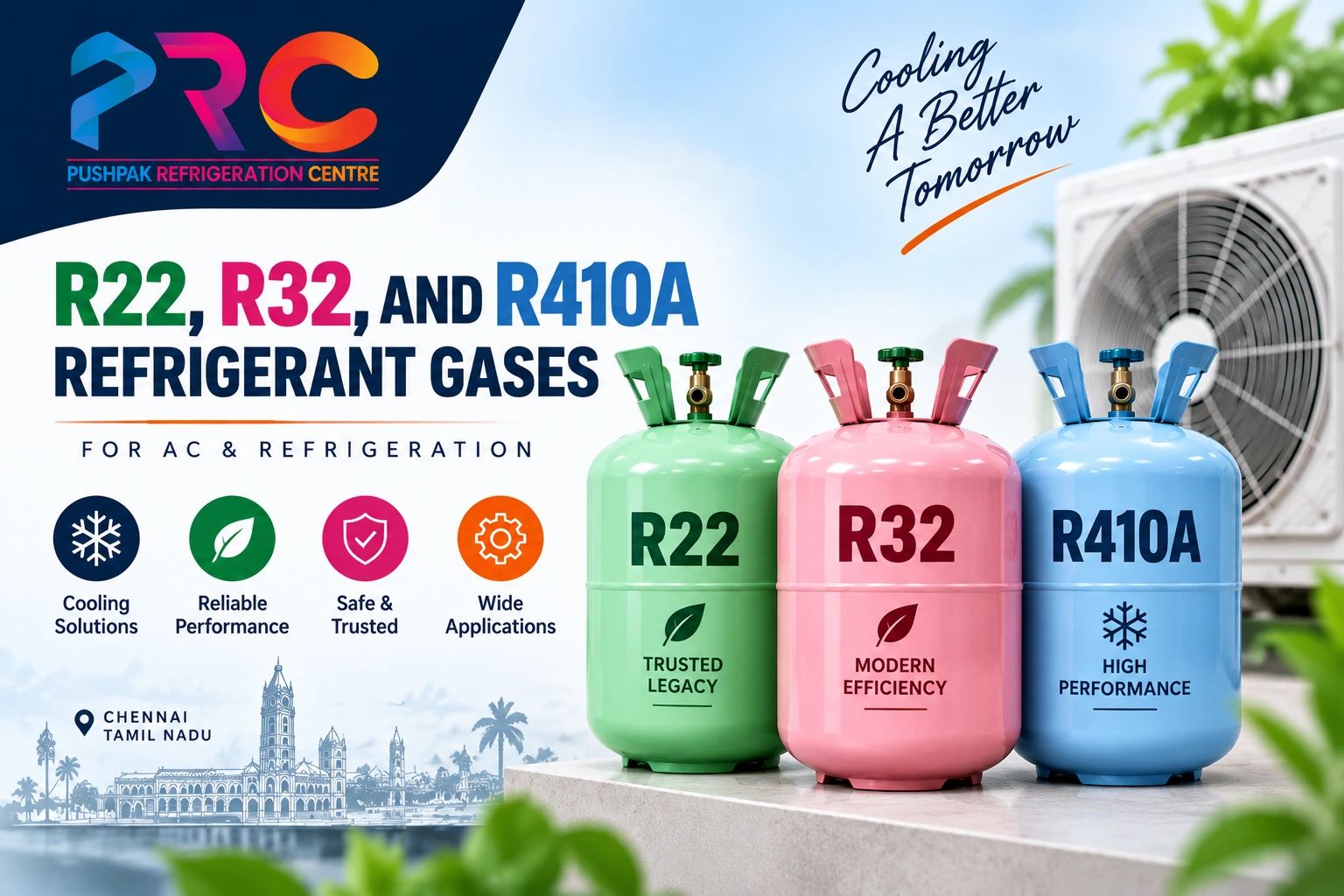
R22 vs R32 vs R410A Refrigerant Gas: A Complete Guide for AC and Refrigeration Systems
Refrigerant gas is one of the most important components of an air-conditioning or refrigeration system. From residential air conditioners to commercial cooling equipment, refrigerants play a key role in transferring heat and maintaining the required temperature.
Among the commonly discussed refrigerants in the HVAC industry are R22, R32, and R410A. However, many customers, technicians, and business owners have questions about how these gases differ and which refrigerant should be used in a particular system.
This guide explains the basics of R22, R32, and R410A refrigerant gases, their applications, differences, safety considerations, and why using the correct refrigerant is essential.
What Is Refrigerant Gas?
A refrigerant is a working fluid used inside an air-conditioning or refrigeration system to transfer heat.
Contrary to popular belief, an air conditioner does not simply “produce cold.” Instead, the refrigerant absorbs heat from the indoor space and transfers that heat outside.
The refrigerant continuously moves through a closed cooling cycle involving:
- Evaporation
- Compression
- Condensation
- Expansion
This continuous process allows an AC or refrigeration system to maintain the desired temperature.
In simple terms:
Refrigerant absorbs heat from one location and releases it in another location.
How Does Refrigerant Work in an AC System?
To understand the difference between R22, R32, and R410A, it is useful to understand the basic refrigeration cycle.
1. Heat Absorption
Inside the indoor unit, the refrigerant flows through the evaporator coil.
Warm air from the room passes over the coil, and the refrigerant absorbs heat from that air.
As the refrigerant absorbs heat, it changes from a low-pressure liquid into a vapour.
2. Compression
The refrigerant vapour then travels to the compressor.
The compressor increases the pressure of the refrigerant, which also increases its temperature.
At this stage, the refrigerant becomes a high-pressure, high-temperature vapour.
3. Heat Rejection
The hot refrigerant travels through the outdoor condenser coil.
The outdoor fan helps remove heat from the refrigerant and release it into the surrounding environment.
As the refrigerant loses heat, it changes back into a liquid.
4. Expansion
The refrigerant passes through an expansion device, where its pressure and temperature are reduced.
It then returns to the indoor coil to absorb more heat.
This cycle continues while the AC or refrigeration system is operating.
What Is R22 Refrigerant Gas?
R22, also known as HCFC-22, was widely used in older air-conditioning and refrigeration systems.
For many years, R22 was a common refrigerant in:
- Window air conditioners
- Split air conditioners
- Commercial cooling equipment
- Refrigeration systems
- Older HVAC installations
Key Characteristics of R22
R22 became popular because of its reliable cooling performance and widespread compatibility with older equipment.
However, R22 is now associated with environmental concerns, particularly because of its ozone depletion potential.
As a result, many countries have gradually reduced or phased out its use in new equipment under environmental regulations.
Important Note
If your existing AC is designed for R22, you should not automatically replace it with another refrigerant.
The refrigerant type must always match the equipment manufacturer’s specifications.
Why Is R22 Being Phased Out?
R22 belongs to the HCFC refrigerant family.
HCFC refrigerants can contribute to ozone layer depletion. Because of this environmental impact, many countries have introduced restrictions and phase-down programmes for R22 and other ozone-depleting substances.
The transition away from R22 has encouraged manufacturers to develop and use alternative refrigerants such as:
- R32
- R410A
- Other newer refrigerants
However, the availability and legal use of refrigerants can vary by country and region.
Always follow the applicable local regulations and equipment manufacturer recommendations.
What Is R32 Refrigerant Gas?
R32 is a modern refrigerant commonly used in newer air-conditioning systems.
It is especially popular in many modern residential split AC and inverter AC models.
Unlike blended refrigerants, R32 is a single-component refrigerant.
Why Is R32 Popular?
1. Suitable for Modern AC Systems
R32 is used in many air conditioners designed specifically for this refrigerant.
Modern AC manufacturers have developed equipment and components that are compatible with R32 operating characteristics.
2. Good Energy Performance
When used in properly designed equipment, R32 can support efficient cooling performance.
However, the actual energy efficiency of an AC depends on several factors, including:
- Compressor technology
- System design
- Installation quality
- Ambient temperature
- Maintenance
- Refrigerant charge
Therefore, refrigerant type alone does not determine the overall energy efficiency of an AC.
3. Lower Environmental Impact Compared With R22
R32 has no ozone depletion potential.
It is generally considered to have a lower global warming impact than R410A and is significantly different from older refrigerants such as R22.
However, refrigerant environmental performance should always be considered as part of the complete system, including:
- Refrigerant leakage prevention
- Recovery and recycling
- Proper servicing
- Energy efficiency
Is R32 Flammable?
R32 is classified as a mildly flammable refrigerant under relevant safety standards.
This means R32 systems require proper handling and servicing procedures.
Safety practices include:
- Ensuring adequate ventilation
- Keeping ignition sources away
- Using compatible service equipment
- Following manufacturer guidelines
- Performing proper leak detection
- Avoiding uncontrolled refrigerant release
R32 should be handled by trained and qualified HVAC technicians.
What Is R410A Refrigerant Gas?
R410A is a refrigerant blend that has been widely used in modern air-conditioning and HVAC systems.
It was introduced as an alternative for systems that previously relied on older refrigerants such as R22.
R410A has been used in many:
- Split air conditioners
- Central air-conditioning systems
- Commercial HVAC systems
- Heat pumps
- Modern cooling equipment
Important Characteristics of R410A
R410A systems generally operate at higher pressures compared with traditional R22 systems.
Because of these differences, R410A equipment requires components designed specifically for its operating conditions.
These may include:
- Compatible compressors
- Suitable copper tubing
- Correct service valves
- Proper pressure-rated components
- Compatible lubricants
- Appropriate servicing tools
R22 vs R32 vs R410A: Quick Comparison
| Feature | R22 | R32 | R410A |
|---|---|---|---|
| Refrigerant Type | HCFC | HFC | HFC Blend |
| Common Application | Older AC & refrigeration systems | Modern AC systems | Many modern AC & HVAC systems |
| Ozone Depletion Potential | Yes | No | No |
| System Generation | Older | Newer | Modern |
| Operating Pressure | Lower than R410A | System dependent | Higher than R22 |
| Flammability Classification | Generally non-flammable | Mildly flammable | Generally non-flammable |
| Direct Replacement for Another Gas? | No | No | No |
Important:
This comparison is intended for general understanding. Always check the exact refrigerant requirements of your equipment.
Can R32 Be Used Instead of R22?
No, Not as a Direct Replacement
One of the most common questions is whether R32 can simply be filled into an R22 air conditioner.
The answer is no.
R22 and R32 systems may differ in:
- Operating pressure
- Compressor design
- Lubricant requirements
- System components
- Safety requirements
- Refrigerant charge procedures
Simply removing R22 and filling R32 into the same system can cause serious performance and equipment problems.
Never change refrigerants without professional evaluation and manufacturer-approved procedures.
Can R410A Replace R22?
Not Directly
R410A should not simply be added to an R22 system.
R410A operates under different conditions and generally requires equipment specifically designed for its pressure and performance characteristics.
Using R410A in equipment designed for R22 can potentially cause:
- Compressor damage
- High-pressure problems
- Component failure
- Refrigerant leaks
- Reduced cooling performance
- System safety issues
The correct refrigerant should always match the equipment design.
Can R32 and R410A Be Mixed?
No
R32 and R410A should not be mixed together in an AC system.
R410A is already a refrigerant blend, while R32 is a single-component refrigerant.
Mixing refrigerants without an approved technical procedure can affect:
- System pressure
- Cooling performance
- Refrigerant composition
- Compressor operation
- Equipment reliability
Always use the refrigerant specified by the manufacturer.
Which Refrigerant Is Better: R22, R32, or R410A?
There is no single refrigerant that is “best” for every air conditioner.
The best refrigerant for your system is the one specified by the equipment manufacturer.
If your AC is designed for R32:
Use R32.
If your AC is designed for R410A:
Use R410A.
If your existing equipment is designed for R22:
Consult a qualified HVAC professional regarding servicing, approved refrigerant options, and applicable regulations.
The most important rule is:
Never select a refrigerant simply because it is cheaper, easily available, or commonly used in another AC model.
How Can You Find Out Which Refrigerant Your AC Uses?
Most air conditioners have a specification label.
You can usually find it:
- On the outdoor unit
- Near the compressor section
- On the equipment nameplate
- Inside the user manual
The label may show information such as:
Refrigerant: R32
or
Refrigerant: R410A
or
Refrigerant: R22
It may also show the refrigerant charge quantity.
For example:
Refrigerant Charge: 650 g
However, knowing the refrigerant charge amount does not mean that refrigerant should be added without proper testing.
A qualified technician should determine whether the system actually requires servicing or has a refrigerant leak.
Signs of a Possible Refrigerant Leak
A refrigerant leak can affect cooling performance.
Some possible warning signs include:
1. Reduced Cooling
The AC may take longer to cool the room or may not reach the desired temperature.
2. Ice Formation on the Pipe or Coil
Ice may sometimes form on the indoor coil or copper pipe.
However, ice formation can also be caused by:
- Dirty air filters
- Low airflow
- Fan problems
- Other system faults
Therefore, proper diagnosis is important.
3. AC Running for Long Periods
If the AC runs continuously but does not provide effective cooling, a refrigerant issue may be one possible cause.
4. Higher Electricity Consumption
Poor cooling performance may cause the AC to operate for longer periods, potentially increasing electricity consumption.
5. Unusual Sounds
In some situations, a refrigerant leak may produce an unusual hissing sound.
However, this alone is not enough to confirm a leak.
Why Simply Refilling Refrigerant Is Not Always the Solution
A properly sealed refrigeration or air-conditioning system does not normally consume refrigerant like fuel.
If the refrigerant level is repeatedly becoming low, there may be a leak.
The correct service process may include:
Step 1: Leak Detection
The technician identifies the location of the leak.
Step 2: Leak Repair
The damaged joint, valve, pipe, or component is repaired.
Step 3: Pressure Testing
The system is tested to ensure that it can hold pressure correctly.
Step 4: Vacuum Process
Air and moisture are removed from the system using appropriate vacuum procedures.
Step 5: Correct Refrigerant Charging
The correct refrigerant is charged according to the manufacturer’s specified procedure and quantity.
Why Correct Refrigerant Charging Matters
Both undercharging and overcharging can affect system performance.
Too Little Refrigerant May Cause:
- Reduced cooling performance
- Poor system efficiency
- Longer operating time
- Possible compressor stress
Too Much Refrigerant May Cause:
- Abnormal system pressure
- Reduced efficiency
- Compressor problems
- Performance issues
For this reason, refrigerant charging should never be based only on guesswork.
Proper servicing may involve calibrated tools and manufacturer-approved charging procedures.
The Importance of Copper Pipes in Refrigerant Systems
Copper pipes play an essential role in AC and refrigeration systems.
They carry refrigerant between different parts of the system, particularly between the indoor and outdoor units.
A quality copper piping installation should consider:
- Correct pipe diameter
- Proper insulation
- Leak-free connections
- Clean internal pipe surfaces
- Correct brazing practices
- Pressure testing
- Proper pipe routing
Poor copper pipe installation can contribute to refrigerant leakage and reduced system performance.
Why Quality Copper Pipes Matter
Using suitable copper pipes and proper installation practices can support reliable system performance.
Better Refrigerant Flow
Correct pipe sizing helps maintain appropriate refrigerant flow throughout the system.
Reduced Risk of Leakage
High-quality materials and properly completed joints can help reduce the possibility of refrigerant leaks.
Improved System Reliability
Well-installed copper piping can support the long-term operation of an AC or refrigeration system.
Better Cooling Performance
Correct pipe sizing, insulation, and installation can influence the overall performance of the cooling system.
Safety Tips for Handling Refrigerant Gases
Refrigerants should always be handled responsibly.
Important Safety Guidelines:
- Use trained and qualified technicians
- Check the refrigerant label before servicing
- Do not mix different refrigerants
- Use compatible tools and equipment
- Ensure proper ventilation
- Keep refrigerants away from ignition sources
- Wear appropriate safety equipment
- Check for leaks using proper methods
- Follow manufacturer instructions
- Follow local environmental and safety regulations
Extra precautions are particularly important when servicing mildly flammable refrigerants such as R32.
Frequently Asked Questions About R22, R32 and R410A
1. Which refrigerant is used in modern air conditioners?
Many modern air conditioners use R32, R410A, or other newer refrigerants. The exact refrigerant depends on the AC model and manufacturer.
2. Can I replace R22 with R32?
No. R32 should not be directly used as a replacement for R22 without approved technical modifications and professional evaluation.
3. Can R32 and R410A be mixed?
No. These refrigerants should not be mixed in the same system.
4. How often does an AC need refrigerant refilling?
A sealed AC system does not normally consume refrigerant. If refrigerant levels are repeatedly low, the system should be inspected for leaks.
5. Which refrigerant is best for my AC?
The best refrigerant is the one recommended by the equipment manufacturer for your specific model.
6. Is R32 safe to use?
R32 is used safely in properly designed equipment, but it is classified as mildly flammable and must be handled according to proper safety procedures.
7. Can I use any refrigerant in my AC?
No. Always use the refrigerant specified by the manufacturer.
Final Thoughts
R22, R32, and R410A are refrigerants associated with different generations of air-conditioning and refrigeration technology.
R22 is mainly found in older cooling systems and has been subject to environmental phase-out measures.
R32 is widely used in many modern air-conditioning systems and is known for its lower environmental impact compared with some older alternatives.
R410A has been widely used in modern HVAC equipment and operates under different conditions compared with R22 systems.
The most important thing to remember is:
The correct refrigerant is not determined by price or availability. It is determined by the design and specification of the equipment.
Using the wrong refrigerant, mixing gases, or refilling a leaking system without proper repair can affect cooling performance and potentially damage the equipment.
For reliable performance, refrigerant selection, leak detection, copper pipe installation, and gas charging should always follow manufacturer guidelines and proper HVAC servicing procedures.
Refrigeration and AC Solutions in Chennai
Pushpak Refrigeration Centre provides products and solutions for air-conditioning and refrigeration requirements.
Our product range supports technicians, businesses, retailers, and cooling system applications, including refrigeration materials and copper pipes used in AC and refrigeration installations.
Contact Pushpak Refrigeration Centre
📞 Phone: 98401 01130
🌐 Website: pushpakrefrigerationcentre.com
📍 Chennai, Tamil Nadu
